Why smoke ends up inside
When wildfires burn hundreds of kilometres away, the smoke can still settle over Canadian cities for days. Most of what makes it harmful is too small to see: Health Canada says fine particles, called PM2.5, represent the main health risk from wildfire smoke
.1 Those particles don't stay outside. They come in through open windows, gaps around doors, bathroom fans and ventilation systems that pull in outdoor air.
That's why the advice for smoky days is mostly about the air inside your home: keep the outside air out, and clean what's already in.
Read the AQHI before you open a window
Canada's Air Quality Health Index (AQHI) is the number to check. It runs from 1 to 10+, and during wildfire smoke events Environment and Climate Change Canada adjusts the formula so that it uses only PM2.5.2 You'll find it in most weather apps and at weather.gc.ca.
- 1–3
- Enjoy your usual outdoor activities.
- 4–6
- At risk, with symptoms: consider easing off outdoor effort.
- 7–10
- At risk: reduce or reschedule strenuous activity outside. A good moment to close the windows and run a purifier.
- 10+
- At risk: avoid strenuous activity outdoors.
At 7 or higher (high risk), the guidance is that people at risk should reduce or reschedule strenuous outdoor activities
, and everyone else should consider doing the same if they have symptoms like coughing or throat irritation. Above 10, people at risk should avoid strenuous activity outdoors.2
Who's most at risk
Health Canada lists people with lung or heart conditions or other chronic illness, people aged 65 and older, infants and young children, and pregnant people, along with people who work or exercise outdoors.1 If someone in your home is on that list, a cleaner-air room is worth setting up before the next smoke day, not during it.
Set up one cleaner-air room
You don't need to filter the whole house. Pick the room where the most vulnerable person spends the most time, usually a bedroom, and make it the cleanest air in the house.
- Close it up. Health Canada's advice for portable air cleaners is to keep doors and windows closed while it runs.3
- Use a HEPA air cleaner sized for the room (more on sizing below). Health Canada notes that portable cleaners
often achieve a high CADR by using a high-efficiency particulate air (HEPA) filter
.3 - Run it high and run it long. In Health Canada's words,
higher fan speeds and longer run times will increase the amount of air that's filtered
.3 Start it as soon as the AQHI climbs, not when you can smell smoke. - Don't add particles of your own. The US EPA's point is simple: filtration
does not replace the need to control pollutants
.4 On smoky days, skip candles and incense, and use the range hood when you cook. - Avoid ozone generators. Both Health Canada and the EPA say to avoid air cleaners that produce ozone, which is a lung irritant.3,4 Sharp's Plasmacluster models release ions. Sharp's product data lists the FP-K50UW as CARB-certified; California's air-cleaner certification includes an ozone emissions test, and its list of certified devices is public. For any other model, ask us and we'll check it for you.
How big an air purifier do you need?
Ignore the biggest number on the box. The one that matters for smoke is the smoke CADR (clean air delivery rate, in cubic feet per minute). Health Canada's rule of thumb: the smoke CADR should be equal to at least two-thirds of the room's area
in square feet, for a standard 8-foot ceiling.3
So a 12 × 15 ft bedroom (180 sq ft) needs a smoke CADR of at least 120. A 300 sq ft living room needs at least 200. Higher ceilings or open stairways mean you should go bigger.
| Room | Smoke CADR needed | Fits |
|---|---|---|
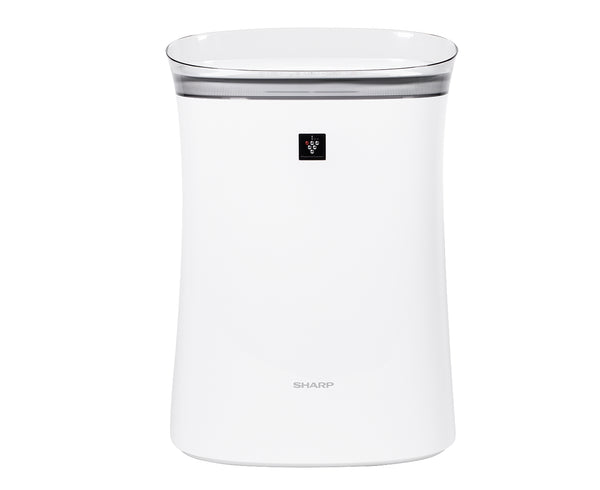
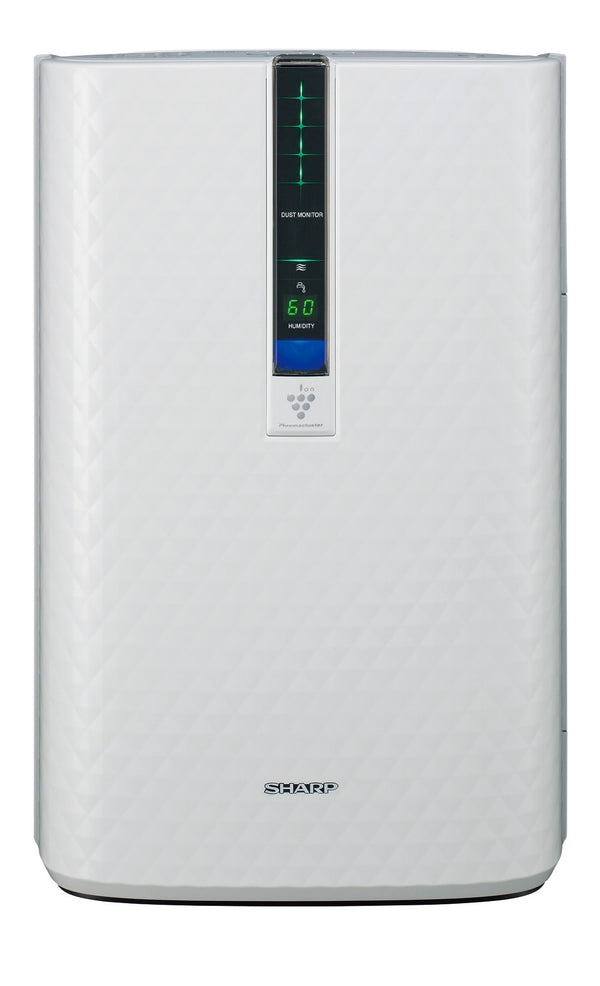
| Small bedroom or office100–150 sq ft | 67–100 | FP-K50UW or KC860U |
| Main bedroom180–250 sq ft | 120–167 | FP-K50UW or KC860U |
| Living room250–330 sq ft | 167–220 | KC860U |
| Open plan400+ sq ft | 267+ | Two units, or a larger model |
Get ready before the next smoke day
Smoke days tend to arrive with little warning, and air purifiers and filters sell out in the first week of a bad season. A short checklist, done in spring, takes the panic out of it:
- Pick the room and measure it. Length × width gives you the square footage; two-thirds of that is the smoke CADR you need.
- Have the purifier in place and a spare filter on the shelf. If last season was heavy, start this one with a fresh HEPA filter.
- Set up AQHI alerts for your city in your weather app, so you close up before the smoke arrives rather than after.
- Know your furnace or HRV settings. If your system draws in outdoor air, check your manual for how to recirculate instead during smoke events.
- Talk to anyone at higher risk in your family about their plan, including medication, if their doctor has given them one.
After the smoke clears: filters
A smoke season works a HEPA filter harder than a normal month. Sharp rates the KC860U's HEPA filter for up to 5 years in normal use, but heavy smoke shortens that; if the filter looks grey on the intake side or the unit's sensor stays on high in clean air, check it. The replacement HEPA filter (FZ-C150HFU) is $119.99 and the carbon filter (FZ-C150DFU) is $74.99 on this store.
What an air purifier can't do
An air purifier lowers the particles in one room. It doesn't make outdoor air safe, and it isn't a treatment. The EPA is blunt: No air cleaner or filter will eliminate all of the air pollutants in your home.
4
If you feel unwell: Health Canada lists headaches, a mild cough and eye, nose and throat irritation as common effects, and wheezing and asthma attacks as more serious ones. Its advice is to talk to a health care provider or seek urgent medical attention
, and to call 9-1-1 in an emergency.1
Sources
- Health Canada. Wildfire smoke: health effects of exposure. Updated July 2026.
- Environment and Climate Change Canada. About the Air Quality Health Index.
- Health Canada. Using a portable air cleaner to improve indoor air. Updated October 2026.
- US Environmental Protection Agency. Guide to Air Cleaners in the Home.
- Product figures (CADR, coverage, noise, filter life, prices): Sharp Canada product data as listed on this store.
This guide is general information, not medical advice. If you have symptoms or a health condition, talk to a health care provider.