Why winter air gets so dry
Cold air can't hold much water. When January air at −15 °C comes into your house and the furnace heats it to 21 °C, it holds the same small amount of water but now has room for far more, so the relative humidity drops. On the coldest days, many Canadian homes read well under 30% on a hygrometer.
You notice it as static shocks, dry skin and lips, a scratchy feeling when you wake up, wooden floors and furniture opening up at the seams. A humidifier puts water back into the air. The trick is putting back the right amount.
The number to aim for: 30 to 50%
Health Canada's advice is to maintain relative humidity levels between 30% and 50%
in your home, and to measure it with a hygrometer, which it calls an inexpensive tool available at most hardware stores
.1
Why not more? Because damp air causes its own problems. Health Canada links excess moisture to mould and dust mites.1 In a Canadian winter there's a second limit: when it's very cold outside, warm humid air condenses on cold windows and outside walls. If you see water on the inside of your windows in the morning, the room is too humid for that day's temperature. Turn the humidifier down, even if the hygrometer still reads under 50%.
Humidifiers in a child's room
Parents often think about a humidifier for a child's room in winter. Start with where Health Canada says it should go, then make it safe and clean:
- Placement: central, not the bedroom at night. Health Canada's cool-mist humidifier advice is to
keep the humidifier in a central location and out of your bedroom, especially during the night
, and to keep humidity at about 30% in winter.4 A hallway or the main living area near the bedrooms usually works: the moisture spreads, and the machine isn't beside the crib. - No hot water or steam near children. Mayo Clinic recommends cool-mist humidifiers for children because hot water or steam from warm-mist units and vaporizers can burn a child who gets too close, and notes that warm- and cool-mist units humidify equally well.3
- Keep the water fresh. Health Canada says
bacteria can collect and multiply in sitting water
, and that a cool-mist humidifierdoes not boil the water, so it does not kill the bacteria
. Its advice: empty the leftover water after each use andclean and disinfect the water reservoir of your humidifier on a regular basis
.4 - Consider distilled water in mist humidifiers. For ultrasonic and other mist types, Health Canada notes that
the number of particles released into the air is generally much lower when using distilled water
.4 - Keep it out of reach, on a stable surface, with the cord tucked away.
- Watch the hygrometer, not the clock. Small bedrooms reach 50% fast with the door closed.
A humidifier is for comfort. It isn't a treatment for colds, croup or breathing problems. If your child is unwell, ask your doctor, pharmacist or your provincial health line (811 in most provinces).
Evaporative, ultrasonic or warm mist?
| Type | How it works | Good to know |
|---|---|---|
| Evaporative | A fan blows air through a wet wick; water evaporates into the room. | No hot water, no visible mist. The wick needs regular rinsing and occasional replacement. |
| Ultrasonic (cool mist) | A vibrating plate turns water into a fine mist. | Quiet. Minerals in tap water can leave dust; Health Canada suggests distilled water.4 |
| Warm mist / steam | Boils water and releases steam. | Hot water and steam: a burn risk around children.3 |
Better sleep in a dry, closed-up house
Sleep is where dry air shows up first: you wake with a dry mouth or a scratchy throat because you've been breathing heated air for eight hours. The fix isn't to flood the bedroom with moisture. It's to bring the whole sleeping area into the 30 to 50% range during the evening, keep doors open so it evens out, and check the windows in the morning for condensation.
Winter is when homes are sealed tightest, so whatever is in the bedroom air (dust, dander, cooking smells that drifted upstairs) stays there all night. That's why a purifier-humidifier combination makes sense for a bedroom or the main living area: one quiet machine handles both problems. What to look for:
- A humidity sensor, so it adds moisture when the air is dry and eases off as the room approaches the target.
- Low noise on the lowest setting. Under 30 dB is a whisper; it'll run all night without anyone turning it off.
- A tank you can carry and clean. You'll refill and rinse it often.
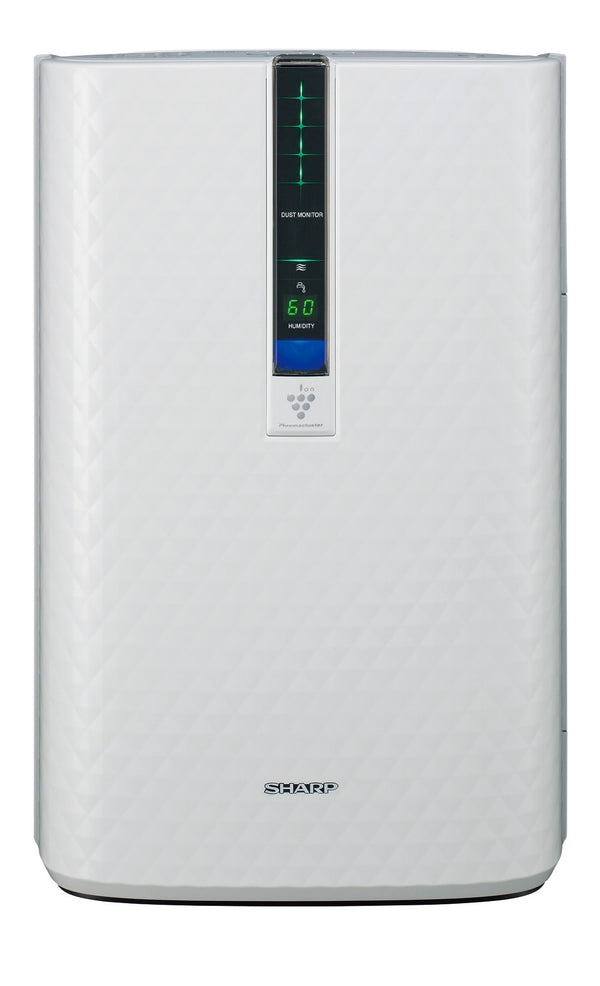
The KC860U is an evaporative unit: no visible mist and no heated water. Health Canada's placement advice above is written for cool-mist humidifiers, and we'd follow it anyway: put the KC860U in the main living area or the hallway outside the bedrooms, not beside a child's bed.
Keeping a purifier-humidifier clean
- Empty and refill the tank instead of topping up old water. Health Canada's advice is to always empty the reservoir when you turn the humidifier off.4
- Rinse the tank and tray on the schedule in your manual, and disinfect them regularly.4
- Replace the wick when it gets stiff or discoloured. For the KC860U it's the FZ-C100MFU humidifying filter, $34.99 on this store.
- Dry it out before you store it in spring, so nothing sits damp all summer.
Sources
- Health Canada. Reduce humidity, moisture and mould.
- HealthLink BC (Government of British Columbia). Controlling dust, dust mites and other allergens in your home.
- Mayo Clinic. Warm-mist versus cool-mist humidifier: which is better for a cold?
- Health Canada. Cool-mist humidifiers.
- Product figures (tank size, sensors, noise, coverage, prices): Sharp Canada product data as listed on this store.
This guide is general information, not medical advice. If you have symptoms or a health condition, talk to a health care provider.